A Backtest replays your strategy on historical data and reports what would have happened. The same declarative config you built in the Designer runs here unchanged — so the thing you test is exactly the thing that will trade.
Data and timeframe
Choose the symbol, the date range, and the Timeframe — the duration of one bar. The timeframe is not cosmetic: the same strategy on 1h and 1d is two different strategies. Pick the timeframe your rules were designed for, and a date range long enough to contain more than one market regime (a bull leg, a chop phase, a drawdown), or you are testing on a single mood.
Single run vs. walk-forward
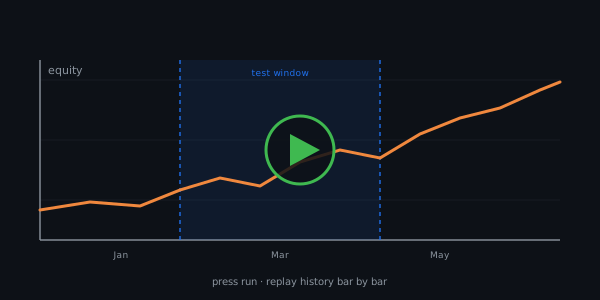
A single run over the whole history with your chosen parameters is the fast first look. But the number it produces is the one most vulnerable to Overfitting. The honest test is Walk-forward: the engine fits on one window, tests on the next, slides forward, and repeats. The aggregated out-of-sample curve is what you should trust — it simulates the live experience of re-tuning over time rather than picking the best parameters in hindsight.
Make the costs real
Confirm the run includes fees, Slippage, and — for perpetuals — Funding. A backtest that assumes zero costs and instant fills produces a beautiful curve that does not exist. Bake the costs in from the first run; a modest result with realistic costs beats a spectacular one with idealised assumptions.
For the full account of what a backtest is — and isn't, including Look-ahead bias and survivorship bias, read the Trading 101 lesson before you trust your first green curve.
Reflexión
Before you run anything: write down the result you expect and why. If the backtest beats your expectation by a lot, your first instinct should be suspicion, not celebration — what would you check first?
Lecturas adicionales
Análisis más detallados sobre este tema en nuestro blog (en inglés).
- The 7 ways backtests lie — and how to avoid themBacktesting pitfalls in algorithmic trading: lookahead bias, survivorship, overfitting, slippage, fees, regime change, and the simulation-vs-reality gap.
- What is walk-forward optimization (and why TradingView strategy testers lie to you)Walk-forward optimization explained: rolling in-sample/out-of-sample windows, anchored vs. non-anchored, and why a single backtest is almost always overfit.
- Monte Carlo backtesting: why one equity curve tells you almost nothingMonte Carlo backtesting for crypto strategies: block bootstrap, trade-order resampling, slippage and entry jitter, and how to read the distribution of outcomes.