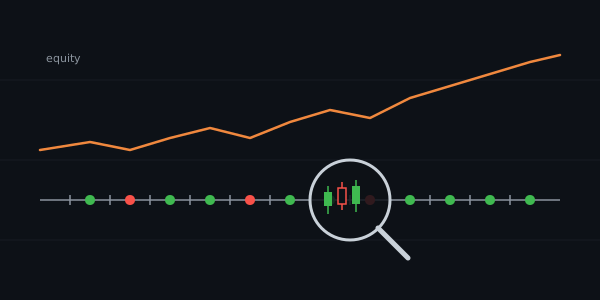
A Backtest replays a strategy on historical price data and reports what would have happened. Done well, it is a structured way to interrogate an idea before risking real money. Done sloppily, it is the most dangerous artifact in trading — a beautiful equity curve that anchors your expectations to fiction.
Look-ahead bias
Look-ahead bias is the single most common defect. It happens whenever your backtest 'knows' something the live system wouldn't have known at the moment of decision. Using today's close to decide today's trade is the textbook case. So is using a moving average computed up to and including the current bar to filter that same bar's signal. Anything you use to decide must have been knowable strictly before the decision was made — nothing else counts.
Survivorship bias
Survivorship bias is the trap of testing on a universe of assets that quietly excludes the ones that already failed. Backtest a 'buy crypto on Mondays' rule on the top-100 coins of 2026 and you are testing on the coins that survived to 2026 — the rule looks like a strategy because it's silently filtering for the assets that went up over the period. Build the asset universe at every point in time, not in hindsight.
Overfitting
Overfitting is what happens when you tune a strategy so closely to one dataset that it learns the noise as well as the signal. You can always make any past return higher by adding parameters and picking the best combination — the question is whether those parameters generalise. They almost never do. The visible warning sign is a Sharpe ratio that climbs as you refine the strategy and then collapses on data the strategy has not seen.
Walk-forward
The honest defence against overfitting is Walk-forward validation. Fit the strategy on a window of past data, test on the next, slide the window forward, repeat. The aggregated out-of-sample equity curve is what you should trust — not the curve from a single backtest run on the whole history with the best parameters picked in hindsight.
A backtest is not proof. It is the strongest piece of evidence you can collect cheaply, before any money is at risk. Pair it with walk-forward, then with paper trading, then with the smallest live size the exchange permits — and adjust your conviction at every step. Markets owe you nothing.
Reflexión
Look at the last backtest you ran. Which of the four pitfalls — look-ahead, survivorship, overfitting, unrealistic costs — could have inflated the result, and by how much?
Lecturas adicionales
Análisis más detallados sobre este tema en nuestro blog (en inglés).
- The 7 ways backtests lie — and how to avoid themBacktesting pitfalls in algorithmic trading: lookahead bias, survivorship, overfitting, slippage, fees, regime change, and the simulation-vs-reality gap.
- What is overfitting in trading? The mistake behind most failed strategiesWhat is overfitting in trading: why strategies fit to historical noise fail live, the warning signs, and how walk-forward and out-of-sample testing prevent it.
- How to read an equity curve like a fund managerHow to read an equity curve: drawdowns, MAR, ulcer index, smoothness, regime-by-regime breakdown. Practical checks before deploying a backtest.