
En esta página
VWAP — the volume-weighted average price — is a benchmark of fair value, not a momentum signal. That single fact decides how you should backtest it. "Buy when price crosses above VWAP" backtests like any other crossover: it whipsaws in chop and gives back its edge to costs. The strategies actually worth testing use VWAP as a *filter* on a directional idea, or as the centre line of a *reversion* setup. This walkthrough builds and validates one of each.
Step 1: pick a role for VWAP, then write complete rules
VWAP works two ways in a rule set. As a trend filter: only take long entries while price is above a rising VWAP, so your directional strategy is gated to the side institutions are leaning. As a reversion reference: when price stretches a long way above or below VWAP — measured by standard-deviation bands around it — fade the move back toward fair value, but only in a ranging market.
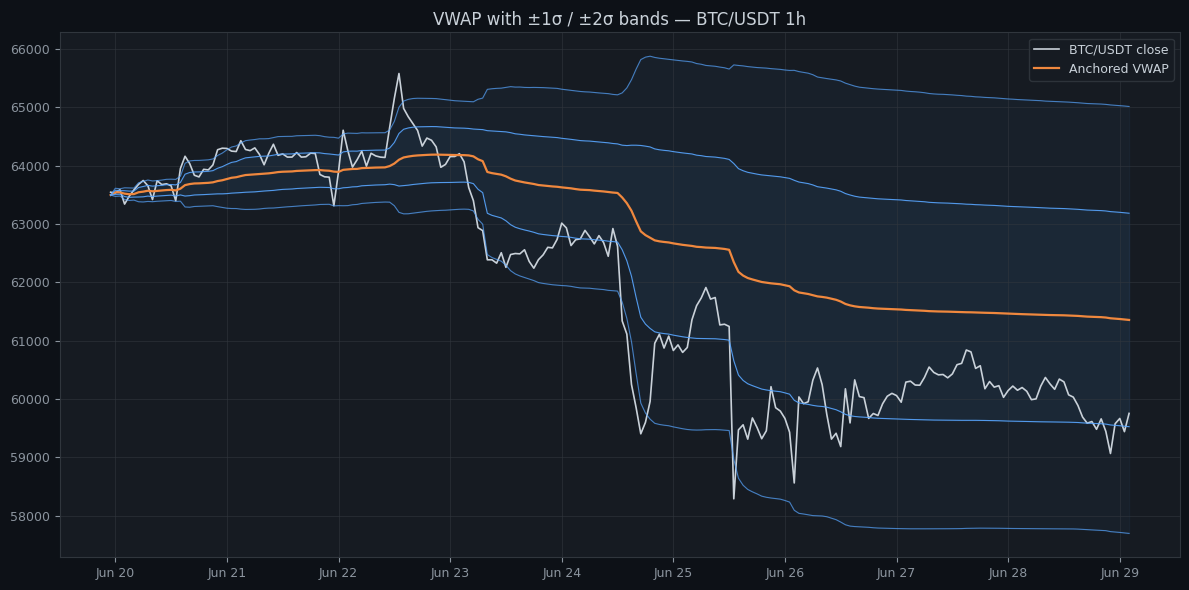
The chart shows VWAP with one- and two-sigma bands. A tag of the ±2σ band means price is stretched far from the volume-weighted consensus — the raw material of a reversion trade. But notice that price can *ride* the band in a strong move, which is exactly why a reversion rule needs a regime filter: fade the bands only when the market is ranging, never in a trend.
Step 2: get clean, session-aware data
Pull real OHLCV for your symbol, timeframe, and exchange. VWAP is volume-weighted, so your data's volume column has to be trustworthy — a feed with bad or missing volume produces a garbage VWAP. Decide, too, whether you want a session-resetting VWAP (the intraday default) or an anchored one; the rule you test must match the line you'd actually trade.
Step 3: run it and read the right metrics
A VWAP *filter* should be judged on whether it improves a base strategy — run the strategy with and without the filter and compare Sharpe, maximum drawdown, and trade count. If the filter only trims trades without lifting risk-adjusted return, it isn't earning its place. A VWAP *reversion* rule typically has a high win rate and small wins, so watch the average loss — one un-stopped reversion trade in a trend can erase a month of winners.
strategy:
  name: vwap_filtered_momentum
  indicators:
    - { id: vwap, kind: VWAP }
    - { id: ema_fast, kind: EMA, period: 9 }
    - { id: ema_slow, kind: EMA, period: 21 }
  rules:
    entry:
      all:
        - { type: crosses_above, left: ema_fast, right: ema_slow }
        - { type: above, left: close, right: vwap }   # only long above fair value
    exit:
      any:
        - { type: crosses_below, left: ema_fast, right: ema_slow }
  risk:
    size_pct: 0.5
    stop_loss_atr: 2.0
Step 4: walk-forward it
Whether VWAP genuinely helps is an empirical question, and the honest way to answer it is walk-forward. Tune the base strategy and the band width on an in-sample window, then test on the next, unseen window with the VWAP rule attached. If "price above VWAP" only improved the numbers because it happened to dodge a couple of bad trades in your history, walk-forward exposes it. If the fair-value context lifts out-of-sample performance, you've found a real filter — see why your live trading underperforms your backtest for why that out-of-sample check matters so much.
Do it in Noon Barbari
VWAP is built in, and a price-vs-VWAP condition drops straight into the visual strategy designer as a filter on any directional rule. Backtest the base strategy with and without it, then walk-forward to confirm the fair-value context is a real edge and not a flattering coincidence. Use VWAP for what it is — a benchmark of fair value — and it earns its keep; trade its crossover and it joins the pile of signals that look good until you test them.
Pruébalo con tus datos
Cada concepto de arriba está implementado en la plataforma. Backtest, walk-forward, paper trading, luego live — el mismo conjunto de reglas en cada etapa.