
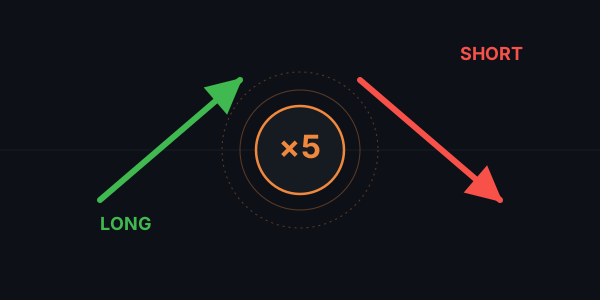
There are only two directions in trading. A Long position profits when price rises; a Short position profits when price falls. Everything else — entry timing, exits, sizing — sits on top of that binary choice.
Spot vs perpetual
A Spot trade is the simplest: you buy the asset, you own the asset, you can sell it later. No expiry, no borrowing, no third party between you and the position. A Perpetual contract (perp) is a derivative — you do not own the underlying, you hold a contract whose value tracks it. Perps allow shorting and leverage, and they introduce one new mechanism in exchange: Funding, a small periodic payment between longs and shorts that keeps the perp price tethered to spot.
What leverage does
Leverage lets you control a position larger than your account balance, by borrowing the difference from the exchange. With 5x leverage, $1,000 of your equity controls a $5,000 position. A 1% move in your favour returns 5% on your equity. A 1% move against you costs 5% of your equity. The math is symmetric until it isn't — see liquidation, below.
Liquidation
Because you borrowed money to open the position, the exchange will close it the moment your remaining Equity can no longer cover the loss — this is Liquidation. At 5x leverage, a 20% adverse move (roughly, before fees and the maintenance margin) wipes out the entire collateral. At 10x, 10% does it. At 20x, 5%. Compare that to the daily range of the asset you trade. Most crypto liquidations are not bad luck; they are predictable consequences of leverage chosen without reference to volatility.
Reflexion
Compute the price move that would liquidate a 10x long on the asset you trade most. How does that distance compare to a typical daily range?
Weiterführende Lektüre
Vertiefende Beiträge zu diesem Thema aus unserem Blog (Englisch).
- Long vs short, explained: how shorting actually works (and breaks)Long vs short explained: the mechanics of borrowing to sell, perpetual swaps, the funding rate, why short risk is asymmetric, and when shorts make sense.
- Leverage and margin, explained: how 10× turns a 5% loss into liquidationLeverage and margin explained: notional vs equity, maintenance margin, liquidation price, how 10x turns a 5% loss into a 50% drawdown, and safer options.