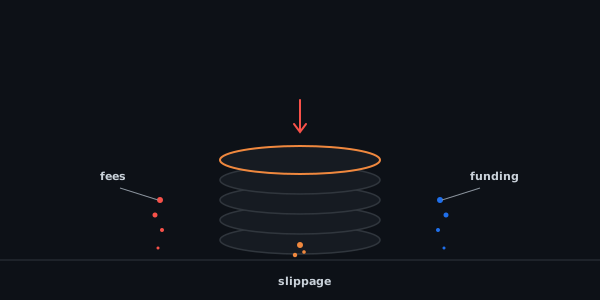
Every trade you take has three small charges attached. Individually they look like rounding errors; together they decide whether a strategy that prints money on paper survives contact with a live exchange. The three are fees, Slippage, and (for perpetuals) Funding.
Fees
Exchanges charge a percentage of every fill — typically between 0.02% and 0.10% per side, depending on tier and whether you provided or removed liquidity. That sounds tiny. Multiplied across hundreds or thousands of round-trips in a backtest, it is the most common single reason a 'profitable' system stops being profitable. A scalper paying 0.10% per side gives the exchange 0.20% on every round-trip; if average winners are 0.5%, fees just ate 40% of every win.
Slippage
Slippage is the difference between the price you expected and the price you got. A market order walks the book — it fills the best-priced offers first, then the next-best, and so on until the size is satisfied. On thin books or during fast moves, the average fill price can be visibly worse than the price you saw on screen when you clicked. Slippage is hard to estimate in a backtest because historical data doesn't show you the book; the honest workaround is to model a fixed slippage assumption (a few basis points on liquid markets, more on illiquid ones) and stick with it.
Funding (perps only)
Hold a perpetual position across a funding window — typically every 8 hours — and you either pay or receive a small amount based on the funding rate. When more traders are long than short, longs pay shorts and vice versa. The rate is usually small (a few basis points), but it accumulates: a strategy that holds positions for days can pay or earn a few percent a month in funding alone, dwarfing the expected per-trade edge on slower setups.
Reflexion
Estimate the round-trip cost (fees + slippage + average funding) of your typical strategy on the exchange you use. How does that number compare to the average win?
Weiterführende Lektüre
Vertiefende Beiträge zu diesem Thema aus unserem Blog (Englisch).
- Slippage and trading costs: the silent tax that kills good strategiesSlippage and trading costs explained: how fees, spread, slippage and funding erode returns, why high-frequency strategies suffer most, and how to model them.
- Bid-ask spread: the cost everyone pays and most traders ignoreBid-ask spread explained: what spread is, why it exists, how it differs across venues and assets, how to measure it in backtest, and how to trade around it.
- Order types, explained: market, limit, stop, stop-limit, OCOOrder types explained: market, limit, stop, stop-limit and OCO — the speed, certainty and price trade-offs each makes, and how they affect backtest realism.