
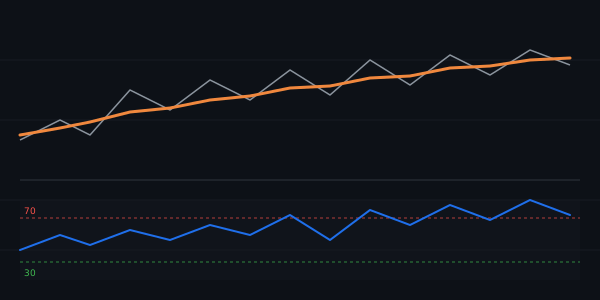
An Indicator is a function applied to historical price (and sometimes volume) that outputs another series of numbers. It is a transformation of the chart, not an oracle reading from it. Every indicator can be reproduced in a spreadsheet with the right formula and a column of prices.
EMA — smoothing the noise
Take the EMA. It is a weighted average of recent closes, with newer prices weighted more heavily than old ones. It does exactly one thing: it produces a smoother version of price, lagging by however many periods you choose. There is no embedded forecast — when traders say 'price closed above the 200 EMA' they are saying 'price is above its smoothed average from the last 200 bars', which is a fact about the past, not the future.
RSI — normalising the velocity
The RSI is a rolling ratio of average up-moves to average down-moves over a window, squashed onto a 0-to-100 scale. It tells you whether recent moves have been mostly up or mostly down, and how strongly. RSI > 70 doesn't mean a top; it means recent action has been one-sided enough that the calculation crossed an arbitrary threshold. The same level marks the beginning of every powerful trend.
What indicators are not
Indicators do not predict price. They re-state the past in a form that highlights one feature — trend, momentum, volatility, mean-reversion potential. That re-statement can be useful when it forces you to act on a fact rather than a feeling. It is not useful when treated as a forecast. A 'sell signal' from RSI is the indicator saying 'recent up-moves have been larger than recent down-moves by a wide margin'; whether that condition keeps tomorrow's price from rising is an open question.
Riflessione
Pick one indicator you actually use. Can you write down its formula from memory? If not, you are trusting a tool you don't understand.
Approfondimenti
Approfondimenti su questo argomento dal nostro blog (in inglese).
- Moving averages, explained from scratch (SMA, EMA, WMA)Moving averages from the ground up: how SMA, EMA and WMA differ, how to pick a period, what they tell you, and the common ways they lie to retail traders.
- The RSI indicator, explained properly — most traders use it wrongThe RSI indicator explained: what Relative Strength Index really measures, why 70/30 levels mislead, and how to use RSI in mean-reversion and trend rules.
- MACD explained: what the histogram is really telling youMACD explained: how the MACD line, signal line and histogram are built, what crossovers and divergence mean, and how to backtest MACD without overfitting.