
Almost every blown account in retail trading is a Position sizing failure, not a signal failure. The trade idea may have been fine; the size that was put behind it was not. Risk management is what lets a real but modest edge eventually compound; without it, even a great strategy dies on a single bad sequence.
Stop loss
A Stop loss is a price level you commit to in advance: if the market trades there, you exit, no debate. The stop's job is not to be a prediction — it is to cap the damage of any single bad call. Place it where being right would mean your thesis is wrong: behind a structural level, beyond an indicator threshold, somewhere price simply should not go if the idea holds.
Position sizing
Once a stop is decided, sizing is arithmetic. Pick a fixed percentage of your account you are willing to risk per trade — 0.5% to 2% for most retail accounts — and compute how many units of the asset put exactly that much money between entry and stop. If the stop is 2% away and you risk 1% of equity, your position is half your equity in notional terms (before leverage).
This is the only correct order of operations: choose risk per trade, choose stop distance, derive position size. Sizing first and stopping wherever leaves you is how accounts die.
The R vocabulary
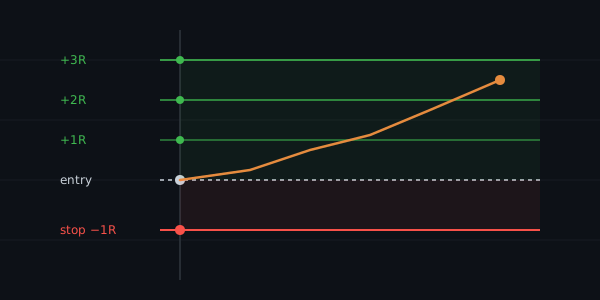
Traders measure outcomes in R — multiples of the initial risk. A trade where the stop was $100 below entry and the exit was $200 above is a 2R winner. A trade stopped out exactly at the stop is a -1R loser. Talking in R instead of dollars normalises across position sizes and lets you compare a 100-trade record meaningfully: a system that averages +0.3R per trade across hundreds of trades is making money even if the dollar amounts look small.
Riflessione
What is the most you have ever lost on a single trade, as a percentage of your account at the time? Was that loss inside your plan, or did sizing run ahead of risk?
Approfondimenti
Approfondimenti su questo argomento dal nostro blog (in inglese).
- Position sizing for crypto traders: the 1% rule revisitedPosition sizing for crypto traders: the 1% rule, ATR-based sizing, Kelly fraction, and why the equities-era rules need adjusting for 24/7 volatility.
- Risk of ruin: the math that decides whether you survive a losing streakRisk of ruin explained: how losing streaks threaten a trading account, what drives the probability of ruin, and how position sizing keeps it near zero.
- Win rate vs risk-reward: why a 90% win rate can still lose moneyWin rate vs risk-reward ratio explained: why win rate alone is meaningless, how expectancy combines the two, and why high-win-rate strategies often blow up.