
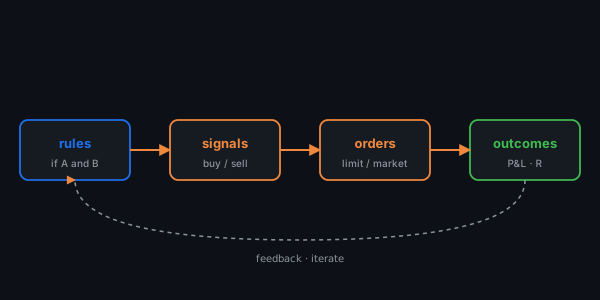
A Strategy is a complete, mechanical pipeline from market state to executed trade. It has four moving parts: rules that watch the market, signals that fire when those rules agree, orders that act on the signals, and outcomes you measure afterwards. If any of those four is vague — even slightly — you have a hypothesis, not a strategy.
Rules → signals
Rules are written as boolean conditions over the data you have. 'RSI(14) crosses above 30' is a rule. 'EMA(20) is above EMA(50) AND price closed inside the upper third of the daily range' is a rule. When the conditions are all true on a given bar, the rule fires a Signal: a single discrete moment that says 'now'.
Signals → orders
A signal is not an order — it is a permission to place an order. Translating signal into order is where size, leverage, stop placement, and order type all need defaults. A serious strategy specifies all of them up front: 'on a long signal, market-buy 1% of equity at risk with the stop placed 1.5 × ATR below entry, take-profit at 2R'. Anything you leave unspecified is a discretionary decision pretending not to be.
Orders → outcomes
Outcomes are the trades that actually filled, with their entry, exit, fees, and final P&L. The metrics you care about are aggregates of these: win rate, average win in R, average loss, Expectancy, Drawdown. Strategies live and die on the aggregates; you cannot judge one from three trades any more than you can judge a coin's bias from three flips.
Reflection
Write down your current strategy on one page — rules, signals, sizing, exits, all of it. What had to become more specific to fit on the page?
Further reading
Deeper dives on this topic from our blog (English).
- How to build a trading strategy from scratch (without writing code)How to build a trading strategy from scratch without code: turn an idea into rules, choose entries and exits, add risk limits, and validate before going live.
- Trend following vs mean reversion: the two ways to make moneyTrend following vs mean reversion: how each makes money, the opposite market regimes they need, their failure modes, and how to combine them in one book.