
On this page
A trader posts a strategy that made money for six months, then watch it slowly bleed for the next three. The rules didn't change. The code is fine. What changed is the *regime* — the underlying character of the market shifted from trending to ranging, and the strategy was only ever suited to one of them. Understanding regimes is the difference between a strategy that "stopped working" and one you knew to stand down.
Two regimes, opposite rules
Markets spend their time in roughly two states. In a trending regime, price moves persistently in one direction — higher highs and higher lows, or the reverse. In a ranging regime, price oscillates inside a band, reverting to a middle. These two states reward opposite strategies. Trend-following — breakouts, moving-average crossovers, momentum — prints in trends and gets chopped to pieces in ranges, buying every false breakout. Mean-reversion — fading the bands, buying oversold — prints in ranges and gets run over in trends, because "oversold" keeps getting more oversold. Neither is better. Each just needs its regime.
You can measure the regime
You don't have to guess which regime you're in. The classic tool is ADX — the Average Directional Index — which measures trend *strength* regardless of direction. A high ADX (above ~25) says a strong trend is in force; a low ADX (below ~20–25) says the market is directionless and ranging.
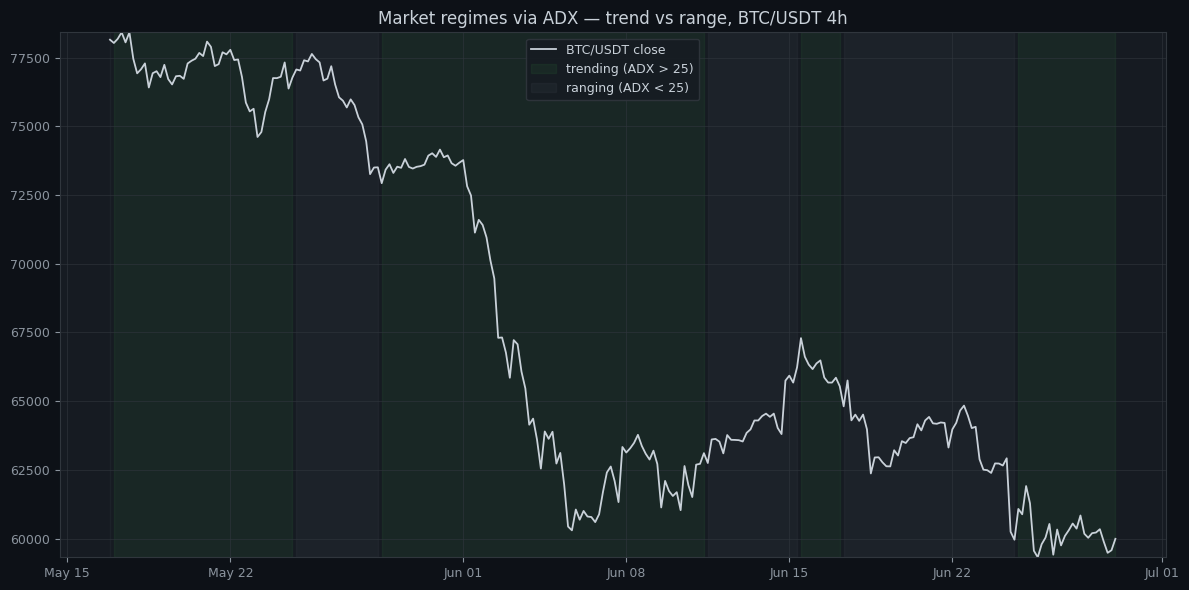
The chart shades BTC by its ADX regime. Notice the alignment: the sharp directional moves fall in the green, trending zones, while the choppy, going-nowhere stretches are grey. A trend strategy run only during the green and a mean-reversion strategy run only during the grey is the whole idea of a regime filter — and it's one of the highest-leverage additions you can make to almost any system.
Why this explains "it stopped working"
When a profitable strategy slowly decays, a regime change is the most common cause — and it's a quieter killer than a crash because nothing dramatic happens. A momentum system doesn't blow up when the trend ends; it just grinds down, taking small losses on each false start while you wait for a move that isn't coming. This is exactly the mechanism behind why most trading bots fail: the bot keeps doing precisely what it was built to do, in a market that no longer suits it.
How to use regimes in practice
Two approaches. The simplest is a filter: gate your strategy to only trade in its favourable regime — trend systems only when ADX is high, reversion systems only when it's low. The more advanced is a switch: run both a trend and a reversion strategy, and let the regime decide which one is active, so you're earning in both states. One caveat keeps you honest: every regime detector lags, because it can only confirm a trend or a range after enough bars have formed. That lag means you'll always give back a little at each regime change — the filter's job isn't to call the turn perfectly, just to keep you out of the regime that bleeds you. As the diversification piece notes, that combination is close to a free lunch — two strategies that profit in opposite regimes smooth each other's drawdowns.
The discipline is to validate the whole thing across more than one regime cycle. A strategy plus filter tested only on a trending year tells you nothing about the ranging year that follows — which is exactly what walk-forward is for. In Noon Barbari you can add an ADX regime filter to any rule set and backtest it with and without, so the regime's effect shows up plainly in the equity curve.
Markets change character. The traders who last are the ones who noticed — and built a rule for it.
Try it on your own data
Every concept above is implemented in the platform. Backtest, walk-forward, paper-trade, then promote to live — same rule set, all stages.