
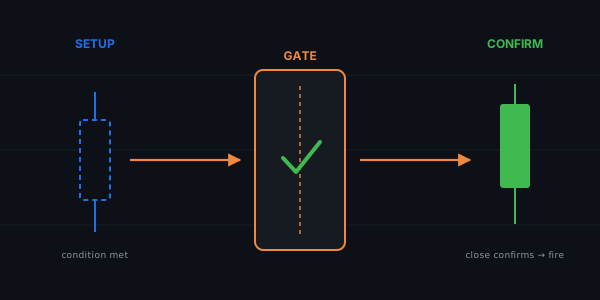
Without a trigger, an entry rule that fires opens a position on the very next bar. A Trigger inserts a second stage: the entry rule is the setup ('after the 100/200 EMA cross, I want longs'), and the trigger is the confirmation ('but only once price pulls back to the fast EMA'). The setup arms the trigger; the trigger opens the trade.
A trigger is configured per direction with a max_wait_bars window. If the confirmation does not happen within that window, the armed signal expires and nothing opens. This is what stops you from chasing a breakout you already missed.
The seven trigger kinds
- pullback — price retraces to a moving level (EMA, SMA, VWAP, Donchian mid). A Pullback gives a better fill inside a trend than buying the breakout.
- rule — any leaf from the rule grammar, reused as a confirmation. Threshold-cross, breakout, volume spike — if you can write it as a rule, you can use it as a trigger.
- time_delay — fire a fixed number of bars after the setup arms. The simplest 'let it settle' confirmation.
- confirmation_candle — wait for a named candle pattern (engulfing, inside-bar, hammer). A Confirmation candle suits reversals, where you want price to commit before you do.
- retest — price breaks a level, returns to it, and holds. A Retest is the standard Smart Money Concepts confirmation: broken resistance becoming support.
- divergence — price and an oscillator move opposite ways. The Divergence trigger is a built-in exhaustion signal for catching the end of a move.
- liquidity_sweep — a wick pierces beyond a prior swing then closes back inside. The Liquidity sweep catches the stop-hunt before a reversal.
Which kind, when
Match the trigger to the trade's logic. Trend-continuation setups want pullback — you have a direction, you just want a cleaner entry. Reversal setups want confirmation_candle or divergence — you need evidence the old move is done. SMC structure plays want retest or liquidity_sweep. And time_delay or a generic rule cover everything in between.
If divergence as a concept is new, the Trading 101 volume lesson introduces it before you wire it up as a trigger here.
Riflessione
For a setup you trade, what single event tells you the move is real rather than a fake-out? That event is your trigger — which of the seven kinds is it closest to?
Approfondimenti
Approfondimenti su questo argomento dal nostro blog (in inglese).
- Smart-order ladders: multi-TP, break-even arming, trailing stopsHow to structure multi-TP smart-order ladders for crypto: partial fills, break-even arming, ATR-scaled trails, and the maths behind each ladder slot.
- Take-profit and stop-loss: the exits that decide your resultsTake-profit and stop-loss: why exits matter more than entries, fixed vs volatility-based vs trailing exits, and how to set them as rules, not emotions.