
Auf dieser Seite
VWAP — Volume-Weighted Average Price — is one of the few indicators that started in institutional trading and filtered down to retail, rather than the other way round. That origin tells you what it is for: it is a benchmark of fair value, not a momentum signal. Used as the former it is genuinely informative; used as the latter it disappoints.
How VWAP is calculated
VWAP is the average price over a period, but with each price weighted by the volume traded there. Sum up price multiplied by volume for every trade, divide by total volume. The effect: a price level where a lot of volume changed hands pulls VWAP toward it; a level that barely traded barely moves it. VWAP therefore answers a precise question — what price did the average unit of this asset actually transact at? That is the market's volume-weighted consensus of fair value for the period.
VWAP vs a moving average
A simple or exponential moving average weights each bar by time — every bar counts equally, or recent bars more. It ignores volume entirely. VWAP weights by volume and ignores time-equality. The practical difference: a moving average can be dragged around by thin, low-volume bars in the small hours; VWAP is anchored to where real participation occurred. When you want a benchmark of where business was genuinely done, VWAP is the more honest line.
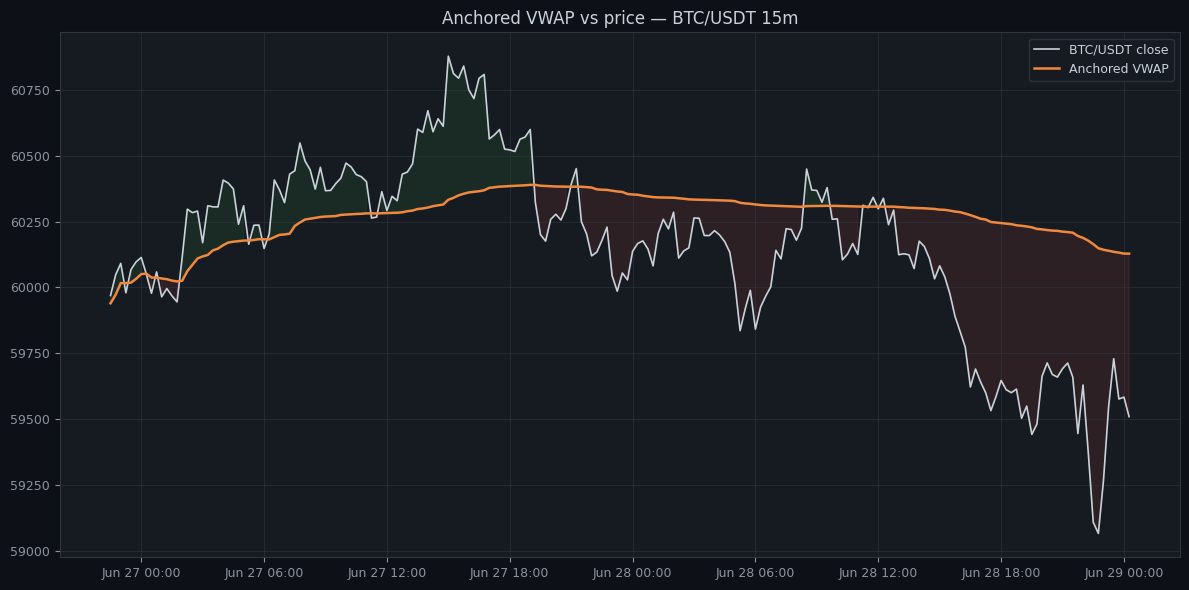
The chart above anchors VWAP to the start of the window and shades each candle by which side of the line price closed on. Read it the way a desk would: through the first session price holds above a gently rising VWAP — buyers are in control and every pullback to the line is bought. When price loses VWAP and the line rolls over on the second day, the character flips entirely, and the level that was support becomes the ceiling sellers defend. The line did not predict the turn; it described, in real time, which side was winning. Many platforms also plot standard-deviation bands around VWAP — turning the single fair-value line into a fair-value *zone*, where a tag of the upper band is stretched rich and the lower band stretched cheap relative to the session's volume-weighted consensus.
How traders actually use VWAP
- As a fair-value reference — price above VWAP means buyers have, on average, paid up today; below means sellers have pressed. It frames whether you are buying rich or cheap relative to the session.
- As dynamic support/resistance — because so many participants watch it, VWAP often acts as a level price reacts to. A pullback to VWAP in an uptrend is a common entry reference.
- As an execution benchmark — institutions judge their own fills against VWAP: buying below it is a 'good' fill. Retail can borrow the discipline — it discourages chasing.
- As a trend-day filter — price holding above a rising VWAP all session is the signature of a strong trend day; repeated crosses back and forth signal a choppy, rangebound one.
What VWAP is not is a crossover signal. "Buy when price crosses above VWAP" backtests poorly for the same reason raw moving-average crossovers do — it whipsaws in chop. VWAP earns its keep as context for a decision, not as the decision.
VWAP is one of the built-in indicators in Noon Barbari's indicator library. In the strategy designer you can use a price-vs-VWAP condition as a filter on a directional strategy and backtest whether the fair-value context actually improves it. On a trend day like the one in the chart that filter keeps you on the right side of the line; in chop, it mostly keeps you out — and only a backtest will tell you whether that trade-off is worth it for your strategy.
VWAP tells you what the market collectively paid, weighted by how much it actually traded. Treat it as a fair-value benchmark — a way to know whether you are buying rich or cheap — and it adds real context. Treat it as a trigger and it joins the long list of crossovers that look good until you backtest them.
Probier es mit deinen eigenen Daten
Jedes Konzept oben ist in der Plattform umgesetzt. Backtesten, Walk-Forward, Paper-Trade, dann live schalten — gleiches Regelwerk in jeder Phase.