
On this page
Here is the most seductive workflow in all of strategy development: take a rule, sweep its parameters across hundreds of combinations, sort by Sharpe, and ship the winner. It feels rigorous — you tested *everything*. It is, in fact, the single most reliable way to manufacture an edge that does not exist. Understanding why is the difference between a strategy and an expensive illusion.
Why searching guarantees a winner
If you test 500 parameter combinations on one slice of history, some of them will look spectacular *by chance alone*. Markets are noisy; over any fixed window, random luck will hand a few parameter sets a gorgeous equity curve that has nothing to do with a repeatable edge. The more combinations you try, the higher the best one scores — not because the strategy got better, but because you gave randomness more lottery tickets. This is overfitting by another name: you have fitted your parameters to the noise in one specific past.
The arithmetic is unforgiving. Test a thousand parameter combinations and, even on a strategy with zero true edge, you should *expect* several to post a backtest Sharpe above 2 from luck alone. The optimiser can't tell skill from noise — it just hands you the top of the list, and the top of a long enough list is almost always noise wearing a crown.
The tell is in the *shape* of the result, not the height of the peak.
The plateau and the spike
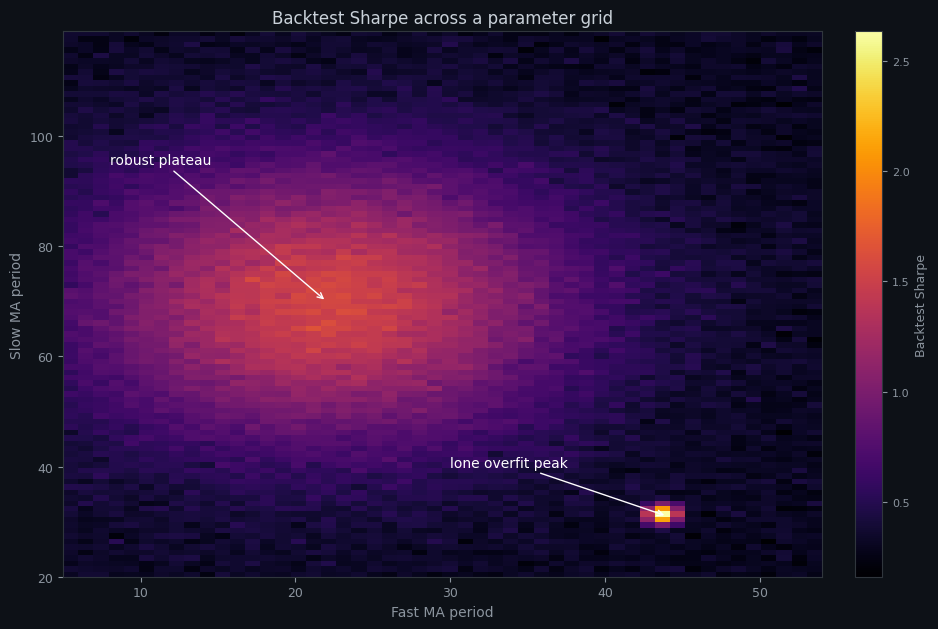
The heatmap above is a backtest's Sharpe across two parameters. There are two very different features on it, and they mean opposite things:
- **The robust plateau** — the broad, warm region where many neighbouring parameter values all perform reasonably well. This is what a real edge looks like: the strategy is not sensitive to the exact numbers, so small changes barely matter. A live market that drifts slightly from your test conditions lands you somewhere else on the plateau, still fine.
- **The lone overfit peak** — the single bright cell standing alone in a sea of dark, dramatically better than every neighbour. This is the one a naive optimiser picks, and it is almost always a fluke. Nudge either parameter by one step and the edge vanishes. Live, the market *will* nudge you off that pixel, and the "edge" evaporates.
The fix: judge regions, validate out-of-sample
Two disciplines defuse the trap. First, prefer plateaus to peaks: pick parameters from the middle of a broad robust region, even if a lone spike scored higher, because the plateau is far more likely to survive into the future. Second, and decisively, validate on data the optimiser never saw. Walk-forward optimization tunes parameters on an in-sample window and then scores them on the *next* window — so a fluke that only worked on the fitting period is exposed immediately, while a genuine plateau holds up. The deflated Sharpe ratio goes further, mathematically discounting your best result by how many combinations you tried.
There's also a simple hygiene rule: the fewer parameters, the less room to overfit. Every extra knob multiplies the combinations you can search and the noise you can fit. A two-parameter strategy that holds up out-of-sample is worth far more than a six-parameter one that needed every degree of freedom to look good.
See it for yourself
Noon Barbari's optimiser is built around this exact discipline — it surfaces the parameter surface and a robustness score, not just the single best number, and you can walk-forward any tuning to see whether your "best" parameters are a plateau or a peak. The goal of optimisation is never the highest backtest. It is the most *robust* one — the result you can still trust after the market moves on. For the broader picture of why optimised backtests disappoint live, see why your live trading underperforms your backtest.
Try it on your own data
Every concept above is implemented in the platform. Backtest, walk-forward, paper-trade, then promote to live — same rule set, all stages.