
Sur cette page
A backtest is a simulation of trading on a *specific* venue, and the venue's details change the answer. If you intend to trade on Binance, a backtest run on another exchange's fees, pairs, and data is testing a different market. This guide covers what makes a Binance backtest actually match Binance — and the single number most retail backtests get wrong.
Use Binance's own data
Start with the right candles. The same pair trades at slightly different prices and volumes on every exchange, so backtest on Binance OHLCV for the exact symbol and timeframe you'll trade. This matters most for volume-weighted indicators like VWAP, where Binance's volume profile differs from a smaller venue's and produces a different signal. It also matters for liquidity: Binance's deep order books make slippage assumptions more realistic than they'd be on a thin exchange, but only if you tested on Binance's actual prices. See the Binance exchange guide for the pairs and specifics.
Model the fee that breaks most strategies
Here is the number retail backtests routinely ignore: Binance's standard spot taker fee is 0.1% per side, or about 0.2% round-trip (lower with BNB discounts or higher VIP tiers, but 0.1% is the honest default to assume). That sounds tiny until you count how often an active strategy pays it.
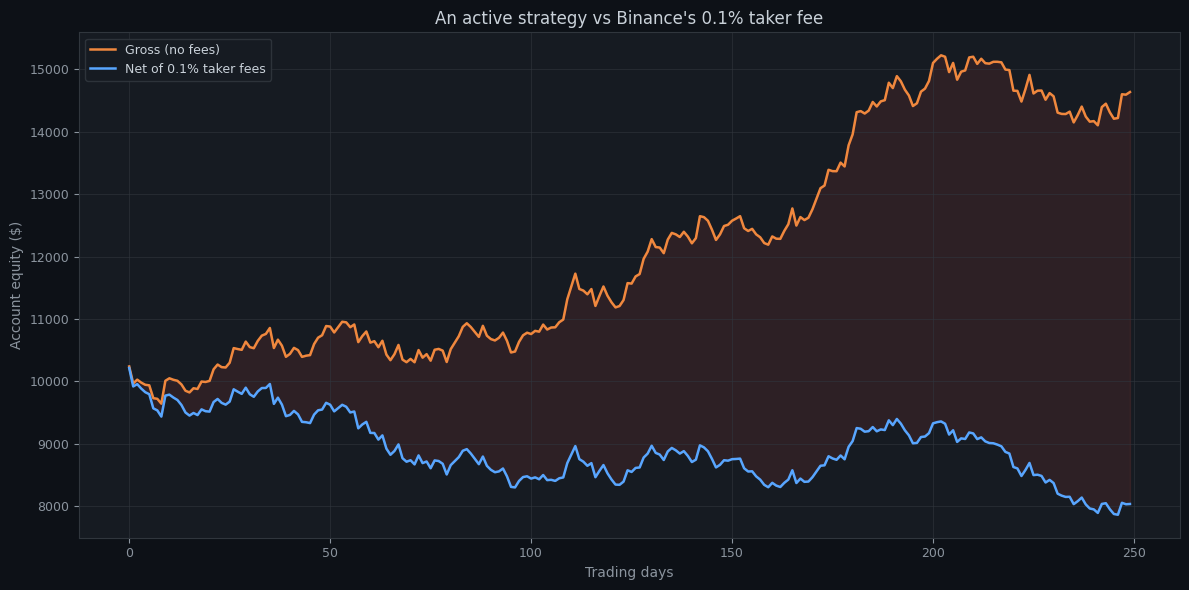
The chart shows the same strategy with and without Binance's taker fee. For a high-turnover system the drag is enormous — fees alone can flip a profitable-looking backtest into a losing one. The fix is twofold: always model the real fee in the backtest, and where the strategy can tolerate the fill uncertainty, use maker (post-only) orders, which on Binance cost less and sometimes rebate — turning the fee from a tax into a smaller one.
Pick liquid pairs and a realistic window
Binance lists hundreds of pairs, but backtest on the liquid ones — BTC/USDT, ETH/USDT, the majors — where your slippage assumptions hold. A strategy that "works" on a thin altcoin pair is usually exploiting backtest fills that the real, shallow order book would never have given you. And test over a window with more than one regime: a Binance backtest that only spans a bull run flatters everything, fees included.
Spot vs futures on Binance
Decide which Binance market you're testing for, because the cost model differs. Spot trading pays the taker fee and nothing else. Binance futures (perpetuals) charge a lower headline fee but add funding — a recurring payment between longs and shorts every eight hours that a spot backtest never models. Hold a perpetual position for days and funding can quietly dwarf the trading fees, so if you'll trade perps your backtest has to include it or it's testing a cheaper market than the one you'll face. Leverage changes the risk math too: a stop that's comfortable on spot can be a liquidation on 10×, so size for the margin you'll actually use.
Validate before you automate
Everything that makes any backtest honest still applies on Binance: evaluate rules on bar close to avoid look-ahead bias, check the data for bad prints, and above all walk-forward the parameters so you're not curve-fitting to Binance's past. Remember Binance's API rate limits when you go live, too — a strategy that fires dozens of orders a minute in a backtest can hit them in reality and miss fills the test assumed it got. Then paper trade against Binance's live feed before risking real capital — the gap between a clean backtest and live fills is real, and it's the subject of why your live trading underperforms your backtest.
Do it in Noon Barbari
Noon Barbari fetches real Binance OHLCV and lets you set the exchange and fees so the backtest matches the venue you'll trade — choose Binance, model the 0.1% taker cost, build your rules in the designer, and walk-forward to confirm the edge survives net of fees. The strategies that clear Binance's fees out-of-sample are the only ones worth automating there.
Essaie-le sur tes propres données
Chaque concept ci-dessus est implémenté dans la plateforme. Backtest, walk-forward, paper trading, puis passage en live — même jeu de règles à chaque étape.